
Innovative solutions for security
Explore the differences between Cisco Application Centric Infrastructure (ACI) and traditional data center networking. Learn how spine-leaf architecture, VXLAN, application-centric policies, automation, security segmentation, and centralized management co
Cisco ACI vs. Traditional Data Center Networking: Which Architecture Is Right for Your Enterprise?
Understanding the Evolution from Traditional Networking to Application-Centric Data Center Infrastructure
Modern data centers support business-critical applications, virtualized workloads, cloud connectivity, storage systems, and increasingly dynamic infrastructure requirements.
As enterprises modernize their data centers, network architects must evaluate whether to continue using traditional device-centric networking or adopt software-defined, policy-driven solutions such as Cisco Application Centric Infrastructure (ACI).
Both approaches can deliver reliable enterprise connectivity. However, they differ significantly in configuration models, operational management, security segmentation, automation, and application integration.
At Pruthvija Technologies, we focus on designing secure, scalable, and resilient data center networks aligned with enterprise requirements.
This article examines the key architectural and operational differences between Cisco ACI and traditional data center networking.
1. What Is Traditional Data Center Networking?
Traditional data center networking typically uses individually configured network switches and routers to provide Layer 2 and Layer 3 connectivity between servers, applications, storage systems, and external networks.
Common technologies include:
-
Cisco Nexus switching with NX-OS
-
VLANs and trunk interfaces
-
Virtual Routing and Forwarding (VRF)
-
OSPF and BGP routing
-
Spanning Tree Protocol
-
Virtual Port Channels (vPC)
-
Link Aggregation Control Protocol (LACP)
-
Access Control Lists (ACLs)
-
Firewall integration
-
VXLAN EVPN in modern fabric designs
Traditional architectures may use a three-tier core, aggregation, and access model or a modern two-tier spine-leaf design.
Advantages
-
Familiar CLI-based operational model
-
Flexible device-level configuration
-
Broad interoperability options
-
Suitable for smaller and established environments
-
Incremental modernization opportunities
-
Ability to automate through APIs and external tools
Limitations
Depending on the design and operational processes, traditional environments may experience:
-
Configuration inconsistencies across devices
-
Manual provisioning overhead
-
Complex VLAN and routing management
-
Fragmented security policy administration
-
Limited centralized visibility without additional tools
-
Increased operational complexity as infrastructure grows
These limitations are not universal. Well-designed NX-OS fabrics can address many of them through automation, telemetry, and modern overlay technologies.
2. What Is Cisco ACI?
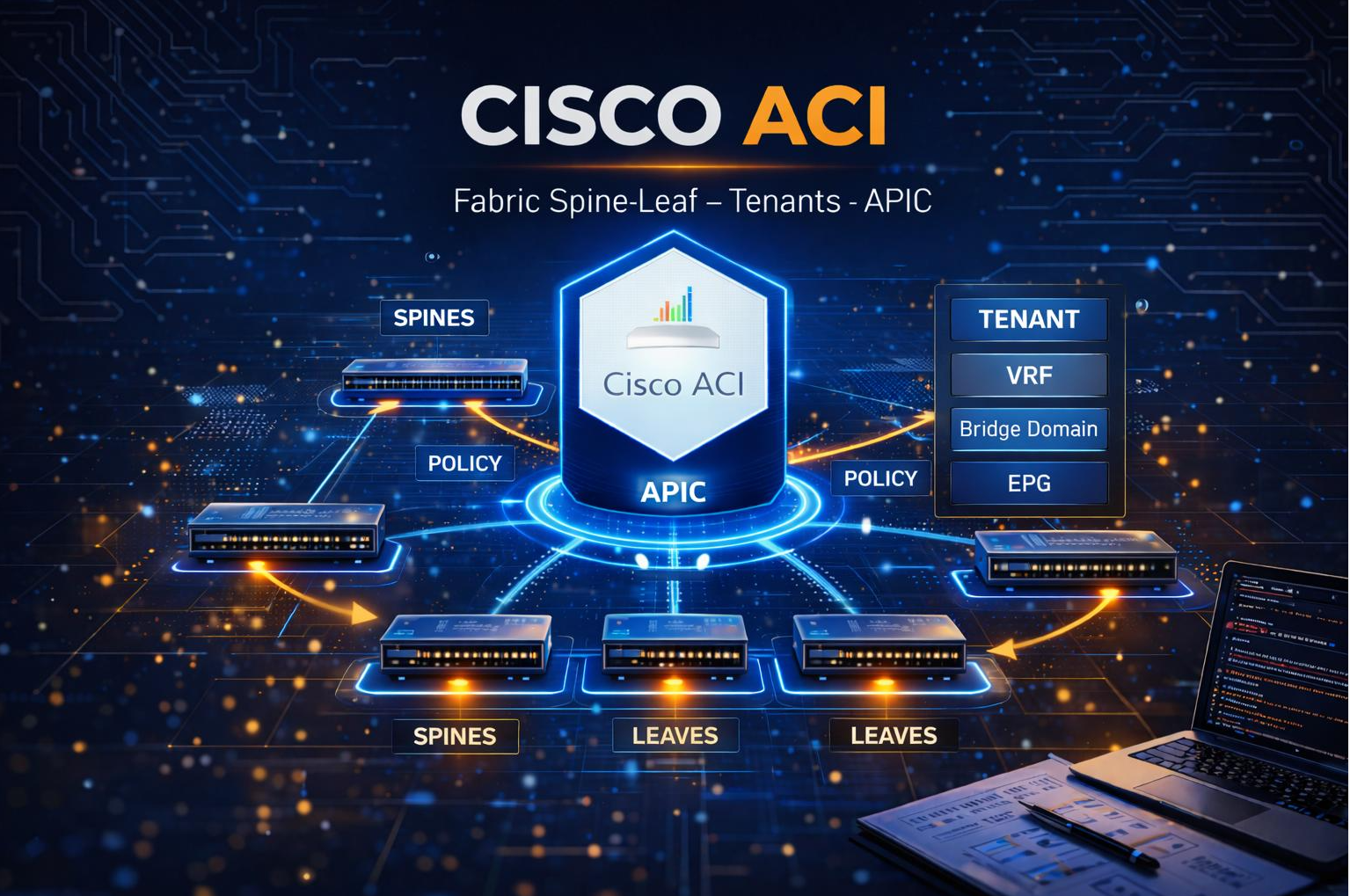
Cisco Application Centric Infrastructure (ACI) is a software-defined data center networking solution that combines Cisco Nexus switching infrastructure with centralized policy management and automation.
ACI uses an application-centric approach in which administrators define connectivity and security requirements through logical policies rather than configuring each switch independently.
Core Components
Cisco APIC: The Application Policy Infrastructure Controller provides centralized fabric configuration, policy management, automation, and operational visibility.
Spine Switches: Provide high-speed transport connectivity between leaf switches.
Leaf Switches: Connect servers, virtualization hosts, storage infrastructure, firewalls, and external networks.
VXLAN Fabric: Provides overlay connectivity across the Layer 3 fabric.
Endpoint Groups (EPGs): Organize endpoints with common networking and security requirements.
Contracts: Define permitted communication between endpoint groups.
ACI allows the network to be managed as an integrated fabric while forwarding and policy enforcement occur on the switches.
3. Architecture: Traditional vs. Cisco ACI
Traditional Three-Tier Architecture
A traditional design may consist of:
Core → Aggregation → Access → Servers
The core provides transport connectivity, the aggregation layer handles policy and routing functions, and the access layer connects workloads.
Depending on the design, Layer 2 extensions and spanning-tree behavior may influence forwarding and failure domains.
Modern Traditional Spine-Leaf Architecture
A modern NX-OS-based data center may use:
Spine Layer → Leaf Layer → Servers
This architecture supports multiple active Layer 3 paths, ECMP, and optional VXLAN EVPN overlays.
Cisco ACI Spine-Leaf Architecture
Cisco ACI also uses a spine-leaf topology, but introduces a unified fabric policy and management framework.
Cisco APIC → Fabric Policy Management
Spine Switches → Leaf Switches → Workloads
Each leaf connects to the spines according to the supported fabric topology.
This provides scalable connectivity and separates the physical forwarding infrastructure from logical application policies.
Key difference: Both ACI and modern NX-OS can use spine-leaf networking. ACI's distinguishing feature is its integrated policy-driven fabric management.
4. Cisco ACI Logical Architecture
Understanding Cisco ACI requires familiarity with several logical constructs.
Tenant
A tenant is a logical container for application and networking policies. It can represent an organization, department, customer, or administrative domain.
A tenant alone does not automatically provide complete network isolation.
VRF
A VRF separates Layer 3 routing domains and allows overlapping IP addressing where supported.
Bridge Domain
A Bridge Domain defines Layer 2 forwarding behavior and associated subnet or gateway settings.
Application Profile
An Application Profile groups EPGs associated with an application or service.
Endpoint Group
An EPG groups endpoints with common connectivity and policy requirements.
For example:
-
Web-EPG
-
Application-EPG
-
Database-EPG
Contracts
Contracts define permitted communication between EPGs through filters and policy rules.
For example, a three-tier application might require:
Web EPG → Application EPG: HTTPS or a defined application port.
Application EPG → Database EPG: A permitted database service port.
Other communication can be restricted according to the configured policy.
By default, unicast traffic between different EPGs requires an applicable contract or another permitted policy mechanism in an enforced VRF. Communication within the same EPG generally does not require a contract.
This model provides application-oriented segmentation while reducing reliance on manually maintained per-device ACLs.
5. VXLAN and Control-Plane Differences
Both Cisco ACI and traditional NX-OS networking can use VXLAN, but the control-plane architectures differ.
Traditional VXLAN EVPN
A conventional VXLAN EVPN fabric commonly uses:
-
IP-based spine-leaf underlay
-
BGP EVPN control plane
-
VXLAN tunnel endpoints
-
VLAN-to-VNI mappings
-
VRF-based segmentation
-
Anycast gateway designs
-
ECMP forwarding
Cisco ACI Fabric
Cisco ACI uses:
-
VXLAN-based fabric encapsulation
-
IS-IS for fabric infrastructure reachability
-
COOP for endpoint location information
-
APIC for policy provisioning
-
Distributed forwarding and policy enforcement
-
MP-BGP for supported external routing functions
Important technical distinction: Cisco ACI does not simply operate as a conventional BGP EVPN fabric. Its internal endpoint distribution and policy mechanisms differ from a typical NX-OS VXLAN EVPN deployment.
6. Network Security and Microsegmentation
Security is one of the most important considerations when comparing the two architectures.
Traditional Data Center Security
Common approaches include:
-
VLAN-based separation
-
VRF segmentation
-
Router and switch ACLs
-
Firewall zones
-
Dedicated security appliances
-
Host-based firewall policies
Security enforcement depends on where these controls are deployed.
Cisco ACI Security
ACI provides integrated policy-based segmentation through:
-
EPGs
-
Contracts
-
Filters
-
VRFs
-
Endpoint Security Groups (ESGs), where supported
-
Intra-EPG isolation options
-
Firewall and service integration
ACI can simplify policy consistency across supported fabric endpoints.
However, ACI contracts are not a complete replacement for next-generation firewalls, intrusion prevention, or application-layer inspection.
Best practice: Combine network segmentation with appropriate firewalls, identity controls, endpoint security, and continuous monitoring.
7. Automation and Centralized Management
Traditional networks can be managed through CLI, configuration templates, APIs, Ansible, Python, and centralized network management platforms.
Cisco ACI integrates a centralized policy framework through APIC.
Cisco ACI Automation Capabilities
-
Fabric provisioning
-
Policy configuration
-
Endpoint connectivity management
-
REST API integration
-
Infrastructure as Code
-
Configuration consistency
-
Centralized health monitoring
-
Supported virtualization integration
ACI can reduce repetitive configuration activities, especially in environments with frequent workload provisioning.
However, successful automation requires careful policy design, change control, version compatibility, and operational knowledge.
8. High Availability and Scalability
Both architectures can support high availability.
Traditional Networking
Common mechanisms include:
-
vPC
-
ECMP
-
LACP
-
Redundant switches
-
Dynamic routing
-
First-hop redundancy
-
Diverse network paths
Cisco ACI
Common mechanisms include:
-
Multiple spine switches
-
Redundant leaf connectivity
-
ECMP forwarding
-
vPC on supported leaf pairs
-
Distributed policy enforcement
-
APIC clustering
-
Supported Multi-Pod and Multi-Site architectures
Neither architecture guarantees uninterrupted application availability by itself.
Application behavior, server redundancy, firewall state synchronization, routing convergence, and storage dependencies must also be considered.
9. Operational Complexity and Troubleshooting
Traditional networking offers direct device-level visibility through CLI commands and standard routing and switching troubleshooting methods.
Cisco ACI introduces centralized fabric health information and policy-based diagnostics, but also requires understanding the relationship between physical interfaces, endpoint learning, bridge domains, EPGs, contracts, and external connectivity.
Common ACI Troubleshooting Areas
-
Endpoint learning and movement
-
VLAN and EPG bindings
-
Bridge Domain configuration
-
VRF routing
-
Contract and filter enforcement
-
L3Out connectivity
-
Fabric link health
-
APIC faults and policy deployment
-
vPC consistency
-
External firewall integration
Best practice: Maintain both physical topology documentation and logical application policy documentation.
10. Cisco ACI Migration Considerations
Migrating from traditional networking to Cisco ACI requires more than replacing switches.
A structured migration should include:
-
Existing infrastructure assessment
-
Application dependency mapping
-
Target ACI fabric architecture
-
Tenant, VRF, Bridge Domain, and EPG design
-
VLAN and endpoint migration planning
-
L3Out and external routing integration
-
Security contract design
-
Firewall and service connectivity
-
Migration testing and rollback planning
-
Operational handover
Brownfield migration may use temporary Layer 2 or Layer 3 connectivity between the existing network and the new ACI fabric.
Applications should be migrated in controlled phases according to approved maintenance windows and business priorities.
11. Which Architecture Should You Choose?
Choose Traditional or NX-OS Networking When:
-
The environment has relatively stable workloads
-
Existing infrastructure meets performance and security requirements
-
Device-level configuration flexibility is important
-
The operations team is experienced with conventional networking
-
An incremental modernization strategy is preferred
-
The organization already operates a well-managed VXLAN EVPN fabric
Consider Cisco ACI When:
-
Centralized application policy management is a priority
-
The data center has frequent workload changes
-
Multi-tenant segmentation is required
-
Fabric-level automation offers operational value
-
Consistent policy management is important
-
The organization can support the required platform investment, licensing, and skills
The final decision should consider total cost of ownership, existing infrastructure, operational readiness, application requirements, and long-term architecture objectives.
12. How Pruthvija Technologies Can Help
At Pruthvija Technologies, our data center networking and infrastructure services focus on secure architecture, implementation, integration, and modernization.
Our service capabilities include:
-
Data center network assessment
-
Cisco Nexus network design
-
Cisco ACI architecture and implementation planning
-
Traditional NX-OS network deployment
-
Spine-leaf fabric design
-
VXLAN EVPN architecture
-
Routing and switching integration
-
Network segmentation and security
-
Data center migration planning
-
High-availability and failover testing
-
HLD and LLD documentation
-
Technical validation and operational handover
We focus on helping organizations select networking architectures that match their technical requirements and business objectives.
Conclusion
Cisco ACI and traditional data center networking both provide viable approaches to enterprise infrastructure design.
Traditional NX-OS networking offers flexibility, established operational practices, and the ability to implement modern VXLAN EVPN fabrics.
Cisco ACI introduces integrated fabric automation, centralized policy management, application-oriented segmentation, and a unified operational framework.
The right architecture is not necessarily the most automated or technologically complex solution. It is the architecture that best supports business requirements, security objectives, operational capabilities, and future growth.
Pruthvija Technologies — Designing Resilient Data Centers. Simplifying Network Operations. Enabling Digital Transformation.
Ready to Modernize Your Data Center?
Contact Pruthvija Technologies to discuss data center architecture, Cisco ACI, VXLAN EVPN, infrastructure migration, and enterprise networking requirements.